Monday, April 26, 2010

What do we need for a stronger economy? An entrepreneurial culture.

This is insightful.

Eric Lefkofsky, one of the most successful business leaders in Chicago believes that the key to sparking our Midwestern economy is a change in culture.

We have the cash. We have the talent. Why are we not growing as many new businesses as California or New York?

Because we don't value risk. We don't embrace entrepreneurs. We are stuck in a culture of risk-aversion.

And that is something we can change today.

Here is his example.


In order to innovate you need a culture that honors risk taking.  One of my co-panelists summed it up perfectly.  When the day comes where a 35 year old husband and father comes home from work one day and says to his wife, “honey I just quit my job today to launch a start-up” and she says “that’s great news” – that’s when you’ll have a culture that honors risk taking.

Unfortunately, we don’t have that culture yet in Chicago.  We don’t encourage people to drop everything and pursue their dreams.   We don’t encourage them to sit in front of a white board and sketch out untested solutions.  We don’t throw money at new ideas.

We don’t start off believing, we start off disbelieving.

The same is true in politics. Too often, the initial reaction to a bill or a proposal or a great idea is to say why it can't be done, why the established powers will never allow it and why it won't happen.

Instead, we need to embrace the new ideas and the new policies that are relevant for growing our economy, not the economy of 1930 or 1950 or 1970.

We need to look at immigration policy (something I debated last night on Beyond the Beltway) as an opportunity to forge a new North American Union, similar to the European Union, to reflect our inextricably linked destinies in Mexico, the US and Canada, rather than reflexively try to throw out the undocumented who stream north.

We need to look at higher education as an economic driver if we reject prestige-driven performance measures (like the US News and World Report rankings) and develop our own performance measures that focus on economic growth through smarter students at the lowest possible cost.

We need to look at our transportation network as another driver of economic growth, and realize our failure to embrace high speed rail for decades has put us at the mercy of oil-producing nations and kept our cities in the Midwest too far apart to operate as one regional unit -- sapping the potential of tying the intellectual capital of our universities to the business savvy of Chicago and smaller cities.

But it all starts with embracing risk and embracing the failure that comes with risk. We should reject the safe path. That leads to mediocrity. It's a powerful thought that our personal valuation of risk can lead to major economic growth for the region -- and significantly better public policies.

How do we build a social norm that celebrates risk?

Friday, April 16, 2010

Taxes....to bury the Axis

We're in the middle of two wars.

The way to pay for those wars is through taxes.

In 1943, in the midst of World War Two, the Walt Disney company put out this video starring Donald Duck to explain why "every American should pay their income tax, gladly and proudly."


(Thanks to Adam Bonin for the link)

Wednesday, March 31, 2010

Video: Change Washington's thinking by recruiting your mayor

Courtesy of the Kansas City Light Rail blog, here is some video of me at the Midwest High Speed Rail Association's annual meeting talking about the power of one individual to change the thinking of federal legislators by convincing their local elected officials to support high speed rail. 


I'm a believer in progressive advocacy starting from the bottom up. 

Thursday, March 25, 2010

The start of Obama's health insurance reform: Room 400 of the Capitol Building in Springfield

I'm a bit inspired by Glenn Beck tonight to write up this post I've been percolating for a few weeks.

He's explaining on his TV show how both Barack Obama is a revolutionary straight out of the 60s implementing a decades-long plan to take over the country. That's why, in his view, President Obama spent so much time passing health care reform. Now the radical is ready for the next sucker punch to America in order to launch a socialist takeover.  That's his theory as to why President Barack Obama spent so much of his political capital to pass health insurance reform into law.

Here is mine.

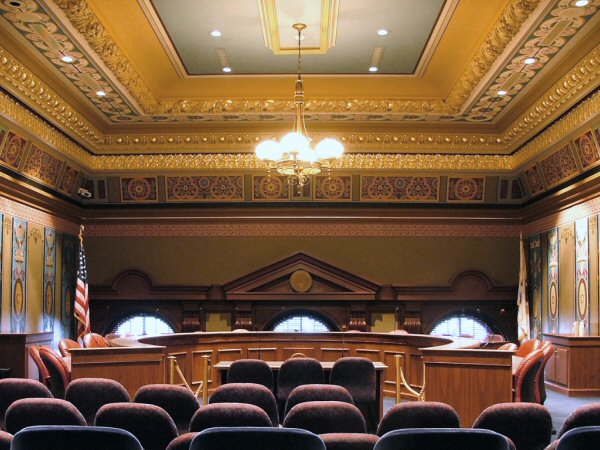
This picture is Room 400 of the Illinois State Capitol in Springfield (thanks to http://www.ilstatehouse.com/ for the link). It's a beautiful Senate hearing room on the 4th floor. And it's where State Senator Barack Obama spent hours and hours in 2003 and 2004 holding hearings as the Chair of the Health and Human Services Committee.

You see, when the Democrats took control of the Illinois Senate in November 2002, Senator Barack Obama could have chaired almost any committee he wanted as a member with some seniority. He chose Health and Human Services. Because even then, one can surmise, he knew that our fundamentally broken health care system was one of the largest anchors pulling down the standard of living of regular folks. And that finding out how to improve that system to help regular people was one of the best uses of his political capital.

I remember watching him chair a committee hearing. The room was packed, but tired, because there was a lot of testimony and a lot of witnesses. State governments administer very large health insurance programs (Medicaid is a joint federal-state program and states have a lot of flexibility to design their own systems) and at the time, Illinois was in the midst of a significant expansion of Medicaid through a new AllKids program. It was rather groundbreaking stuff. There were a lot of experts and advocacy groups sharing perspectives on the consequences of the failures of our health care system and proposals to better regulate insurance companies or expand eligibility to Medicaid for lower-income people, week after week. The hearings were long and frequent. The subject matter was difficult and complicated. And Chairman Obama drank it all in. One question he asked a health care expert at the end of her testimony during a long hearing captured for me his approach to health care policy: "for my own edification, would you mind elaborating on...."  He was personally intellectually engaged in the very knotty problem of diagnosing the structural shortcomings of our health care system and prescribing policy solutions to ameliorate the worst shortcomings.

He spent the time to learn and understand how bad our health insurance really is in practice. He knows the details. He knows the nuances. He knows the consequences. He understands, as only a legislator engaged in the battle for policy improvements against a hostile industry can know, just how important better regulations and policies are to improve the lives of and prevent catastrophes to regular people. And he knew all this before he went to Washington.

So when President Obama faced conventional wisdom in Washington suggesting he scale back the year-long effort or settle for small steps and moving on to the next issue, he refused to quit. And I'm convinced all those hours in Room 400 of the Capitol Building chairing the Health and Human Services Committee came back to him while in the Oval Office these last 14 months to steel his resolve to see health insurance reform through. Because he knew -- he knew -- how people would continue to suffer needlessly without it.

That knowledge of how bad our health system is now and the understanding of why major (but commonsense) government regulations over the for-profit health insurance companies that drove President Obama is also the key for why more and more people over the last week are turning to support the new law. Because as people learn what the law does (and then learn that, before the Obama law, insurance companies could and did throw people out of coverage when they got sick and could and did refuse to cover anyone with a pre-existing condition and could and did take premiums for years and then not pay for medical bills after a lifetime cap), people come to the same conclusion that Chairman Barack Obama came to in Springfield: we need the government to regulate the insurance companies. A lot.

I'm proud that Chairman Barack Obama delivered on health insurance reform for the country. And Glenn Beck's theories of the source of Obama's determination to improve the system notwithstanding, I'm heartened that a big part of the basis of his drive to improve the system came from a full and complete diagnosis of the fundamental shortcomings of our health care system forged in Room 400.

Monday, March 22, 2010

The future of successful cities: massive expansion of universities

This New York Times article explains how New York University intends to expand its physical campus in the City by 40%.

Forty percent!

There are 40,000-some students at NYU today. By 2031, NYU expects to educate 46,500.

That's how to lead the future! As University President John Sexton said "for New York to be a great city, we need N.Y.U. to be a great university."

That means Chicago should be actively encouraging Northwestern, DePaul, Loyola, UIC and the University of Chicago (not to mention Columbia, Roosevelt and Robert Morris) to each be expanding as aggressively as their endowments can support. That's how we'll build the future leaders of our economy. And that's how we'll make Chicago great.

Similarly, Downstate cities in Illinois should do everything in their power to grow the universities in their communities. They should bend over backwards to attract for-profit colleges like Robert Morris to their downtowns. And every community should see their community colleges as engines for growth to spin-off private colleges and other partnerships to grow their educational engine.

I know there's always some blowback from 'the community' that opposes university expansion. That means the expansion should be inclusive of the people who live around the university (especially with investments like hiring students to assist public schoolteachers with their classrooms once a week -- a great program I participated in at the University of Chicago). But it should not mean that expansion is halted. The only path to greatness as a city, region and nation is through intelligence and wisdom. Universities more than any other institution generate that intellectual capital. We need them to be larger and stronger.

Monday, February 15, 2010

Great video on taxing banks a tiny fraction to fund the government

While this is from a UK campaign, the premise is an excellent one: tax banks' speculative investments by a tiny bit in order to fund the government.

It's a great idea and long overdue, especially as income inequality is at its highest level since the 1920s and massive government budget deficits are hurting our economy (we're not investing in education nearly enough, as an example).

They call it the Robin Hood tax. I like it.

Thursday, February 04, 2010

Scott Lee Cohen shows Illinois should use runoffs for primary elections

Illinois primaries should use a runoff, like Chicago elections, to make sure we don't nominate someone the majority of voters wouldn't want.

Scott Lee Cohen's 26% victory (ahead of well-respected Deputy Majority Leader Art Turner's 22% showing) in a six-man race has shown the danger of our plurality elections. When anyone can win with 26% of the vote.....anyone can win.

Republicans might also be feeling a bit concerned with their gubernatorial nominee Senator Bill Brady. He earned 20% of the vote – a virtual tie with his colleague Senator Kirk Dillard. Conventional wisdom suggests the conservative Downstater Brady might be a weaker candidate than the majority of Republicans would have liked.

The easiest way to fix this problem is to hold a runoff election. If no one earns the support of the majority of voters, then no one has yet earned the nomination. A runoff a month or two later between the top two candidates would settle the question and ensure the nominee has the most support in the party.

Does anyone doubt that Representative Turner would earn more support among Democrats than Scott Lee Cohen? And while it's an open question whether Senator Dillard would earn more support than Senator Brady among Republicans, it's a question that ought to be asked and answered in a runoff election. A runoff would guarantee the right person who represent the party, because that person would earn a majority of support, not just 20 or 26 percent in a multi-candidate lottery.

Some political scientists would note that primary runoff elections were traditionally used in Southern states to deny blacks a chance to ever elect anyone. In the land of Obama, that isn't a problem. African-American candidates can earn a majority of the primary vote in Illinois. Just ask Robin Kelly who earned 58% of the vote this week (or Jesse White).

Some others might argue that spending another month or two in a runoff election would take too long. With our early February primary, there is plenty of time to hold a runoff in late March or April. And another month of exposure to the top two candidates in a runoff election would be a very helpful thing for democracy.

Both Chicago and Springfield voters are used to runoffs in city elections. The Illinois General Assembly should require the use of runoffs for statewide primary elections as well to avoid any more mistakes where the person the majority of the party wouldn't want wins the primary.

Wednesday, January 27, 2010

Proof from the experts: stimulus worked. We need another one.

USA Today surveyed 50 top economists and found agreement among one question: did the stimulus work? The answer is absolutely.

The stimulus package (the American Recovery and Reinvestment Act) reduced unemployment by 0.8 percent -- that's 1.2 million people that would have been laid off without our significant increase in government spending during this nasty recession.

It's common sense: if most businesses and people have less money this year and they buy fewer things, then there are fewer jobs for people to make the products or services that the businesses or people would have bought. There is less tax money coming in to state and local governments, so teachers and other government workers get laid off, slowing the economy down even more since the people who are laid off don't have any money to spend. The way to get out of this slow-down in spending is for the one institution that can spend now to keep people employed to do so -- and that's the federal government. Only DC can spend on things we need -- like clean energy and high speed rail and teachers -- when everyone else is out of money. And by spending money this year and next year, we'll build up our economy so that in a few years when our economy is moving again, we can pay back the loans the fedreal government is taking out now.

Or, we can say that "all government spending is bad" and then we'll fire more people and slow down our economy even more.

Ask the experts -- the economists who study how to get more people working. They all agree, according to this USA Today news article -- that the stimulus was successful and that the federal government should pass another one.

Sunday, December 27, 2009

Julie Hamos over Dan Seals and Elliot Richardson for Congress in Illinois' 10th District Democratic primary

Democratic voters from Wisconsin to Wilmette have their first good opportunity in at least a decade to elect a Member of Congress. The dying breed of moderate Republicans in the John Porter mold have represented the north suburban district for two decades (until a few months ago when the current Member of Congress, Mark Kirk, tranformed from a fairly moderate Republican to a hard-right nutjob in order to appeal to those hard-right Downstaters who are still voting in Repulican primaries to get nominated statewide for his U.S. Senate campaign).

That means the seat will be open in November. And that brings us to the February 2, 2010 primary.

In some ways, the frontrunner is Dan Seals, the third-times-the-charm candidate who narrowly lost in 2006 and 2008 to Mark Kirk. After his well-funded campaign, anyone who watched Oprah anytime in October in 2008 knows the name of Dan Seals. As do all of the precinct committeemen and women of the 10th District, and those relationships are paying off for the Seals campaign with some township endorsements. He's an intelligent person and clearly perserverant.

Elliot Richardson is an attorney who launched his own firm. He is also an intelligent person.

But the most qualified candidate with the best skill set to have an impact in Congress if elected is Representative Julie Hamos, one of the Illinois General Assembly's absolute best legislators. Julie has served for 10 years in the Illinois House and worked for more than a decade before that a progressive lobbyist in Springfield figuring out how to pass bills. That is not an easy task. And it is not intuitive. It is not like practicing law or running a business. It is a very difficult combination of policy analysis, negotiation, mobilization, interpersonal relationship managment and consensus-building. Julie is already very, very good at it. And that's the job of a legislator: pass good bills.

I'm struck by the similarities between my endorsement of Barack Obama for Senate in 2004 and Julie Hamos for Congress in 2010.

In the Obama Senate primary, Barack was fond of saying "I'm the only candidate that's passed a bill. I'm the only candidate that's passed a budget." Well, Julie is the only candidate that has passed a bill and she's the only candidate that has passed a budget. Barack was also competing against some smart, talented competitors (Dan Hynes, Gery Chico, Blair Hull), just as Dan Seals and Elliot Richardson are no slouches. Julie was one of the very first legislators to endorse Barack in 2004. (In fact, when Barack gave his speech in Daley Plaza in 2003 speaking out against the Iraq War as a dumb idea when it was difficult to stand up against the loud beating of the war drums, there was only one other legislator who also spoke out against the war: Representative Julie Hamos).

And just as there's something fitting about State Senator Barack Obama seeking election as U.S. Senator Barack Obama, there is something fitting about State Representative Julie Hamos seeking election as U.S. Representative Julie Hamos.

Importantly, Julie is also the strongest Democratic candidate in November. The strongest Republican candidate for the seat is State Representative Beth Coulson, and if Beth wins her primary, then Dan Seals' and Elliot Richardson's lack of any legislative experience will be a real liability against Beth. That legislative experience helped then-State Senator Debbie Halvorson beat concrete magnate Marty Ozinga in the far south suburbs in 2008 to get elected to Congress. I would not want that narrative flipped in the 10th district with a Republican candidate with a better skill set than the Democratic nominee, and only Julie Hamos has the experience and qualifications to match up against Beth Coulson.

One township committeeman summed it up: "Dan Seals is a nice guy and a smart man, but he had two chances at this seat and he didn't get it done. Plus he doesn't live in the district." Julie does live in the district (as does Elliot), and in a close race in November, why give the Republicans any opportunity to turn off a few voters because Dan decided not to move into the district (after running for four years)?

The main reason to support Julie is the same reason I supported Barack for Senate: it is very hard to be a good legislator, and very good state legislators are the ones who become very good federal legislators. Both Barack and Julie were very good state legislators. And I predict Julie will become one of our state's best legislators.

Tuesday, December 22, 2009

"There will be a revolution in primary health care in America." Senator Bernie Sanders (Socialist-Vermont)

One of the many reasons why the Democratic health insurance reform plan is a big improvement to our country is Senator Bernie Sanders and Representative Jim Clybourn's efforts to pump $10 - $14 billion into community health care clinics. Health insurance is all well and good, but health care is the name of the game, and the community health care clinics are about the best investment in providing health care there is (on as close to a single-payer model as we can get).

As Senator Sanders put it in this press conference on C-Span: "If this happens, there will be a revolution in primary health care in America."

That's really exciting. Here is a press release by Senator Sanders' office laying out the impact of the money. By the way, Senator Sanders is a socialist. And if he's a socialist, then so am I. Because getting 25 million (!) people served by a doctor and a dentist is what government ought to be doing. 


As always, it's about the money. And putting $14 billion into hiring doctors, nurses and dentists to provide health care to 25 million people -- with no money-grubbing middlemen parasitic insurance companies driving up costs -- is a great investment (especially because we taxpayers will save even more than the $14 billion because all those Americans will be healthier and won't show up at the very expensive emergency rooms over the next few decades). 

This is Big Government. And it is wonderful. Think about all those people who will be healthy because of it. If you ever thought that maybe Big Government is a bad thing, and maybe you ought to vote against people who might be for Big Government, then this is what you are voting to end: hiring doctors, nurses and dentists to make people healthy. 

We've got to elect some more socialists.